Residential Price Range
Shorter runs with a usable cleanout and manageable debris tend to stay near the lower end. Heavy grease, scale, or root intrusion can raise a residential job to $800 to $1,200.
Phoenix Sewers quotes and performs main sewer line hydro jetting across the Valley every week. When a line slows or backs up, the useful price depends on whether the property is residential or commercial, the buildup inside the pipe, its condition, and how easily the crew can reach it.
Shorter runs with a usable cleanout and manageable debris tend to stay near the lower end. Heavy grease, scale, or root intrusion can raise a residential job to $800 to $1,200.
Pipe material, line length and depth, cleanout access, and the type of clog all move the estimate. Roots and hardened scale require more controlled passes than loose debris.
A camera pass before jetting identifies pipe material, root intrusion, bellies, or breaks. A second pass confirms the line is clear and shows cracks or offset joints that cleaning alone cannot fix.
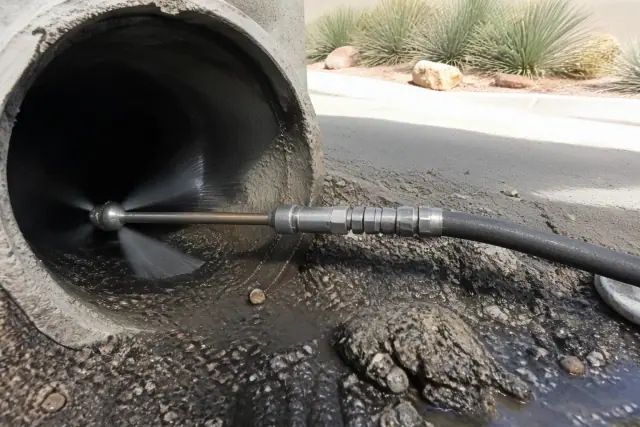
A rotating nozzle sends high-pressure water through the line to scour grease, scale, sludge, and roots from the pipe wall instead of opening only a narrow channel.
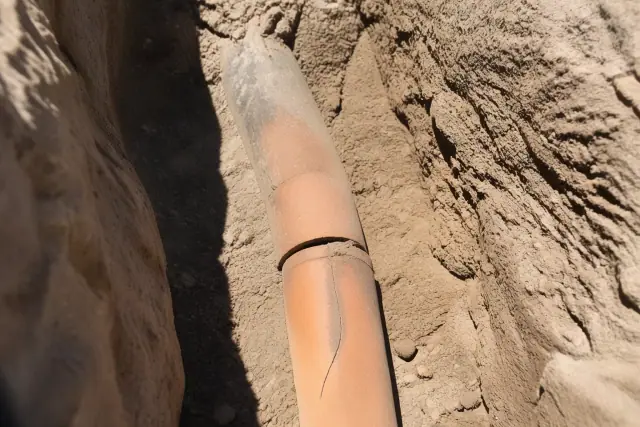
Pipe material and condition determine the safe pressure setting. Older clay or Orangeburg needs a more cautious approach than sound cast-iron or PVC pipe.
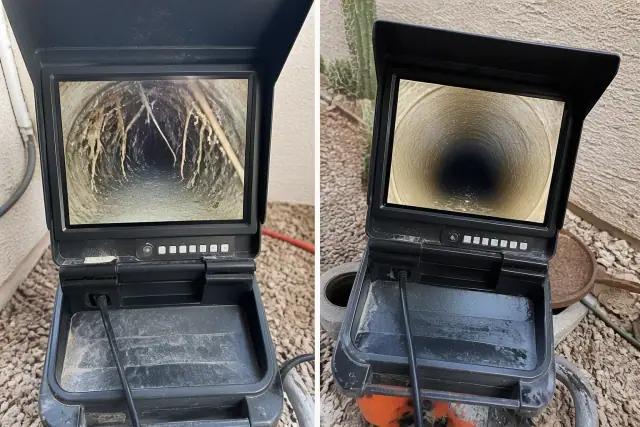
Before-and-after footage distinguishes removable buildup from structural damage. That evidence helps prevent cleaning a line that first needs repair.
A separate sewer camera inspection typically costs $150 to $500 depending on line length and access. It is frequently bundled with hydro jetting so the condition can be checked before and after cleaning.
Minimum service charges generally run $150 to $300 before line length and clog severity are factored into the final scope.
A standard residential job takes about 1 to 2 hours; a severe clog, long run, or new cleanout can extend it to 3 hours or more. Residential equipment typically operates at 3,000 to 4,000 PSI and 4 to 12 GPM, adjusted for pipe material and diameter.
A standard main line may be quoted at a flat rate, while extended or complicated work may use an hourly rate near $350/hour. Confirm whether camera inspection, cleanout access, and the post-service pass are included.
| Service Situation | Typical Cost | Main Decision Factors |
|---|---|---|
| Standard residential main | $300 to $800; most jobs $362 to $620 | Line length, cleanout access, and clog severity |
| Severe residential buildup | Can reach $800 to $1,200 | Heavy grease, scale, or root intrusion |
| Deep line or limited access | Toward the $1,200-$2,000 range | Root masses, line depth, or no usable cleanout |
| Commercial line | $800 to $2,500 | Larger diameters, grease traps, and longer service windows |
| Snaking comparison | $285 to $495 | Clears an immediate blockage but does not scour the pipe wall |
The national hydro jetting range is $200 to $2,500 because a short residential line and a grease-heavy commercial system require very different work. When buildup is the problem, cleaning can be roughly $500 compared with a potential $5,000 repair, but only a camera inspection can show whether the pipe is structurally sound. Annual preventive jetting on a recurring schedule usually costs less per visit than a one-off emergency call.
Homes built before the 1980s in central Phoenix may still have clay or Orangeburg lines that require lower, carefully controlled pressure. Mature roots in Arcadia and Encanto-Palmcroft, long runs beneath driveways or landscaping, and a missing cleanout all add access or cleaning time. Commercial kitchens and multi-tenant properties, including Sky Harbor-area business parks, may add grease traps, larger diameters, multiple stack connections, scheduling constraints, or coordination with the City of Phoenix Water Services Department.
Is hydro jetting worth it? For grease, scale, sludge, or root buildup, it cleans the full pipe wall, while camera verification shows whether the buildup was removed; it cannot repair cracks, bellies, breaks, or offset joints. How is it different from snaking? Snaking generally costs $285 to $495 and opens an immediate channel, while jetting scours the wall. Can you do it yourself? Main lines may run 4 to 6 feet deep, and consumer attachments generally cannot deliver controlled 3,000+ PSI safely on older clay or Orangeburg pipe. When should you schedule an inspection? Multiple slow drains, gurgling, sewer odor, backups at the lowest drain, or a blockage returning within weeks are strong signs; catching root intrusion early with a $300 to $800 service may help avoid a $3,000 to $5,000 excavation repair.
Share which drains are slow or backing up, when the problem began, whether it has returned after snaking, and whether the property has an accessible cleanout. A licensed sewer contractor can inspect the pipe material and condition, confirm the appropriate pressure, and explain what the estimate includes before work starts.