Replacement Scope
A clear 30 to 50 foot residential run is a moderate, well-defined project. A longer line beneath hardscape, dense landscaping, or caliche is substantially harder.
At Phoenix Sewers, sewer line replacement can range from a straightforward one-day trenchless job to a multi-day excavation. The difficulty usually depends less on the pipe itself than on its depth, material, access, soil, and what is built or growing above the run.
A clear 30 to 50 foot residential run is a moderate, well-defined project. A longer line beneath hardscape, dense landscaping, or caliche is substantially harder.
Pipe depth, total run length, yard access, utility crossings, patios, additions, concrete, mature roots, and soil composition determine the excavation effort.
Start with a sewer camera inspection to distinguish a crushed pipe, offset joint, or root intrusion. That finding determines whether an isolated repair, lining, bursting, or full excavation fits the condition.
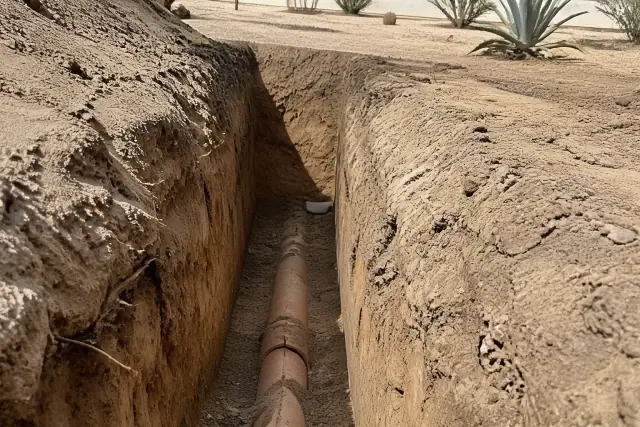
The full pipe run, excavation depth, and nearby hardscape or roots. These site conditions reveal why two replacements can require very different effort.
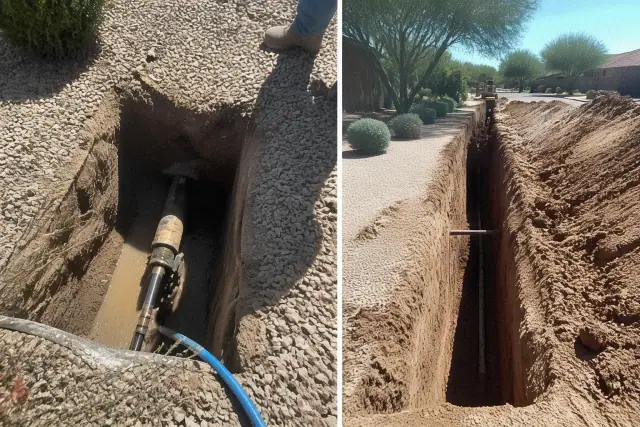
Compare small end pits for a trenchless method with one continuous open trench. The visual should make the difference in surface disruption immediately clear.
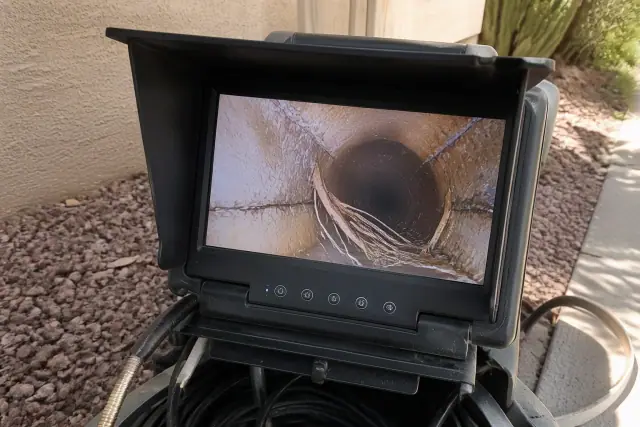
Cracks, invading roots, and the remaining pipe wall. Those details help explain whether the host pipe can accept a liner or needs replacement.
Use a camera inspection to locate and identify the failure, then complete an Arizona 811 utility locate before excavation begins.
Residential lines generally sit 18 to 36 inches deep, while caliche common at 2 to 4 feet in the Salt River Valley can require heavier excavation equipment.
Recurring slow drains, gurgling toilets, yard sewer odor, or soggy patches over the pipe run warrant a camera inspection to identify the cause.
Do not treat a municipal-main tie-in as a DIY materials project. An isolated section may cost a homeowner a few hundred dollars in materials, but failed permitting or inspection can mean digging the trench again.
| Pipe Condition | Likely Approach | Difficulty and Disruption |
|---|---|---|
| Clear route with full access | Open-trench replacement | A defined excavation; a full residential replacement typically takes 3-5 days. |
| Fully crushed or broken line | Pipe bursting | Small access pits replace a continuous trench and may allow a one-day job. |
| Cracks or root intrusion with a sound host pipe | Pipe lining | A cured liner forms a new pipe inside the old one with less surface disruption. |
The hard part is usually reaching the pipe without unnecessary damage to the property. A full open-trench job includes excavation, old-pipe removal, new PVC or ABS pipe set on proper grade, reconnection at both ends, compacted backfill, final grading, and restoration of disturbed landscaping or hardscape.
Clay, cast iron, Orangeburg, and PVC fail or respond to replacement methods differently, and the scope also depends on whether one section is crushed or the full line has failed. A main line that crosses a property line, sidewalk, or street can add Maricopa County right-of-way coordination and traffic control on busier Phoenix corridors. For pipe bursting, a bursting head fractures the old pipe while pulling continuous HDPE behind it; lining instead requires enough structural integrity to cure a resin-saturated liner against the existing wall.
Whether repair costs less than replacement depends on the camera findings: one crushed section may allow an isolated repair, while a fully failed run may justify replacement. The useful life of the line also depends on its material and condition rather than one universal age. In Phoenix, any tie-in to the municipal main requires a permit and inspection, so the scope must account for that process before excavation starts.
Share the drainage symptoms and any known obstacles above the sewer route. A camera inspection can confirm the pipe condition and help define the appropriate repair or replacement scope before excavation.